Visual Novel User Interfaces- My Thoughts
Visual novels benefit from a maximalist approach to UI design. By building out a detailed and intentional infrastructure to support your game's story and themes, you can provide players with meta context to make the experience more memorable, and more intriguing on first glance.
How do we do this? Most UI is already thematic to the game it's attached to. High fantasy games in castles might utilize a blackletter font, cyberpunk games might have neon quick menu buttons. Those are thematic, and that's a great baseline. Thematic UI elements don't contest the story in any way, and even a maximalist UI chock-full of storytelling elements are probably going to have a few things that lean more thematic than storytelling, and that's okay! A screen depicting what button input does what is fine without a clue as to which corporation was really behind the silver mine collapse. But if your quick menu buttons echoed the dastardly company's branding? That's storytelling elements.
However, saying "tell a story with UI" is vague and a difficult start point. There are five directions you can go in to help build out that storytelling. First off, fleshing out characters- detailing them beyond what we experience in the narrative and recontextualizing their actions and motivations. Second, building on plot, like the silver mine collapse example. Your goal here is almost for the story to spill over into its outer world. Third, you can reinforce setting, establish that this town is dusty and forlorn before ever showing a background of said town. Fourth, you can establish tone, helping punchlines land and heartbreak shatter, or by contrasting the presented tone of the scene and making the player do some deeper considerations. Last but not least, you can connect themes- control what players are focused on, build additional context, and frame how they view the story.
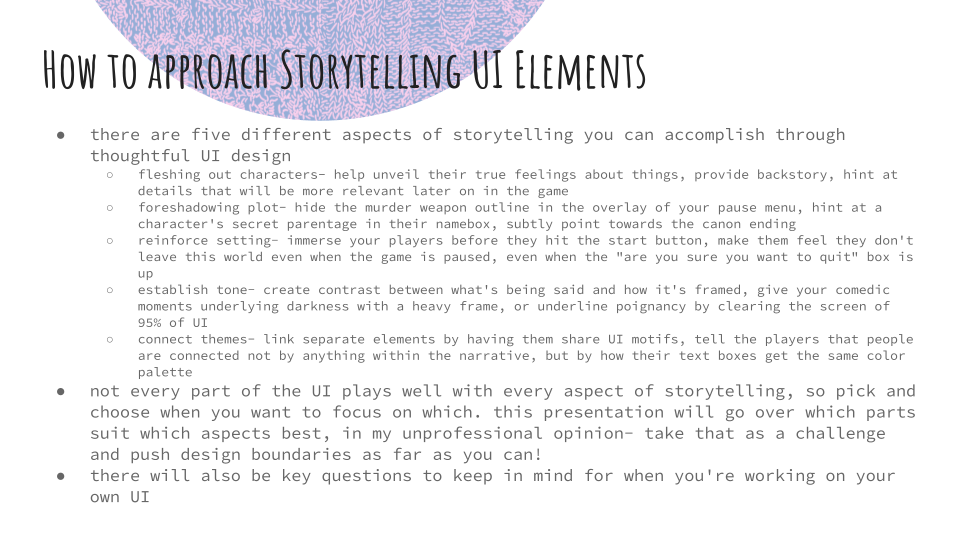
Which direction you want to take different parts of your UI in is really up to you! While certain elements are better suited to some directions than others, like pop up notifications are great for establishing setting but tone can be tricky, the sky is really the limit. The UI exists as your game's outer world and contextualizes the inner world that the player signed up for- so let's review some techniques that you can put into practice!
Techniques
Tech number one- how do we build up that outer world and make it feel relevant? Mini plot lines! Think of mini-plotlines like a comic taking place on the edge of your game, making progress on a story that is linked but maybe not directly discussed within the game.
Tech two, changing the context by reframing different screens and the data they present through UI.
Tech three, foreshadow what's coming. Remember, this doesn't have to make sense when the player first encounters it- you don't want them suspecting too much. Just allow your players to read between the lines and think they know what's coming next- if they're doing analysis to figure out if they're right or not, they're fully immersed in your game.
Tech four is simply creating UI elements from a first-person character POV. Ask yourself what a character would see to represent that data, and then make it into UI.
And now for my personal favorite technique, UI personification. This is my game dev understanding of panel personification that I first heard about in lines in motion's great video about the paneling in Witch Hat Atelier. It's essentially allowing your characters and backgrounds to interact with the UI elements.
Non-integral interactivity is the things that happen in your UI that probably wouldn't be missed if they were gone, and add this additional interest sprinkled throughout your game. Think of not the start button, but the sparkles that fire out from it after pressing.
Last but not least, let's talk about controlling focus, and how UI can shrink or expand on how much of the game world your player is exposed to. Milk outside of a bag of milk outside a bag of milk's opening gives you a very tight lens into the game world starting from the main menu and the sigh of relief that happens once you are out of that claustrophobic UI layout is brilliantly executed even if I felt personally terrified. I like to think of this technique as similar to what Nintendo did in Breath of the Wild and what FromSoft does in several soulslikes, where they keep the player within a claustrophobic area for a while, but then as soon as the game world opens up, it eases tension on the player and replaces it with curiosity and wonder. That exact technique is pretty tricky to do within VNs, but this feels spiritually very similar.
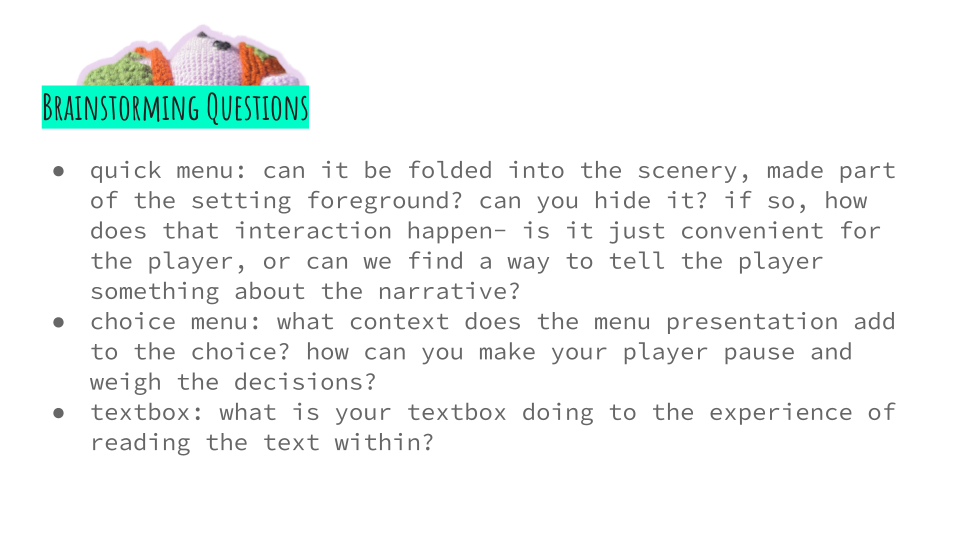
Brainstorming Questions